Salad onions
Also called spring onions and scallions — and official pages do not all mean the same thing
The Society’s salad-onion guide is generous with names. “Salad onions, also called spring onions and scallions, are easy to grow and take up little space.” [source] “Sow little and often for a supply of salad onions from spring through to autumn.” [source]
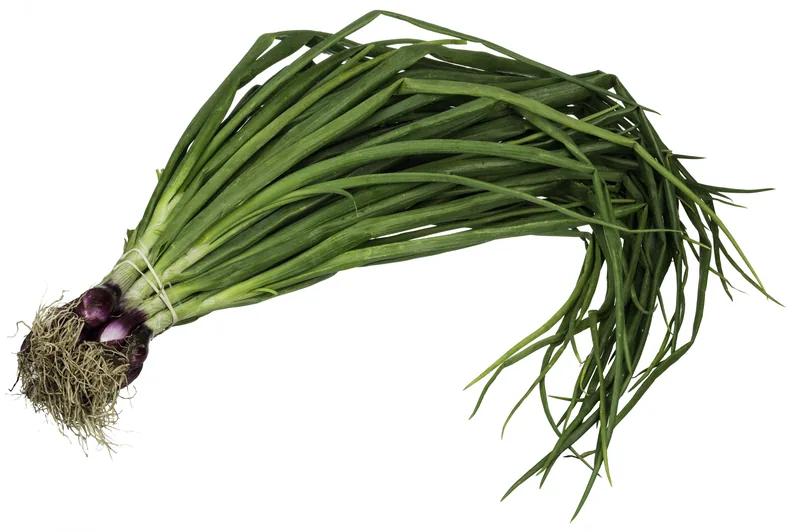
Official wording on that page says they “are varieties of Allium cepa or Allium fistulosum.” [source] That official “or” matters. It is not used here to decide that every bunch in a shop is one species. Varieties “can have white or purple stems,” and may be “cylindrical like mini leeks or with small round white bulbs”; there are also “varieties with reddish-purple bulbs and stems.” [source] Evan-Amos’s 2014 still of a tied red bunch is one official colour of that official range, not a proof of species.
Encyclopaedia Britannica, on its own official page, keeps two entries with official measurements. Spring onions “are small white onions that are picked when between 25 and 38 mm (1 and 1.5 inches) in diameter; the tops are sometimes left attached.” [source] “Green onions, also called scallions, are young onions harvested when their tops are green and the underdeveloped bulbs are 13 mm (0.5 inch) or less in diameter.” [source] This desk does not use those millimetres to rewrite the Society’s three-name crop, or use the Society’s “also called” to erase Britannica’s two official sizes. They sit side by side in the field notes.
Sow “small batches every couple of weeks” for continuous supplies, or sow hardy varieties “in late summer and early autumn for harvesting the following spring,” “ready to harvest from March onwards.” [source] Rows about 20cm (8in) apart, in the ground or in a container. [source] This is a fresh crop, not the winter tray described on the storing page.
Enjoyed this desk of sets, shallots, and a store that wants the light?
No pop-ups. No intrusive advertising. Just interesting stuff. A little support helps the next vegetables.im site get built.