Grow
Sets are easiest. Seed is cheaper. Both official methods stay on the desk.
The Royal Horticultural Society, writing for a British garden, says onions are usually grown from sets — immature bulbs — “the easiest and fastest way to grow them.” [source] Encyclopaedia Britannica, describing commercial crops, says most “are grown from the plant’s small black seeds, which are sown directly in the field.” [source] Those official practices are neighbouring, not combined into one rule for every field.
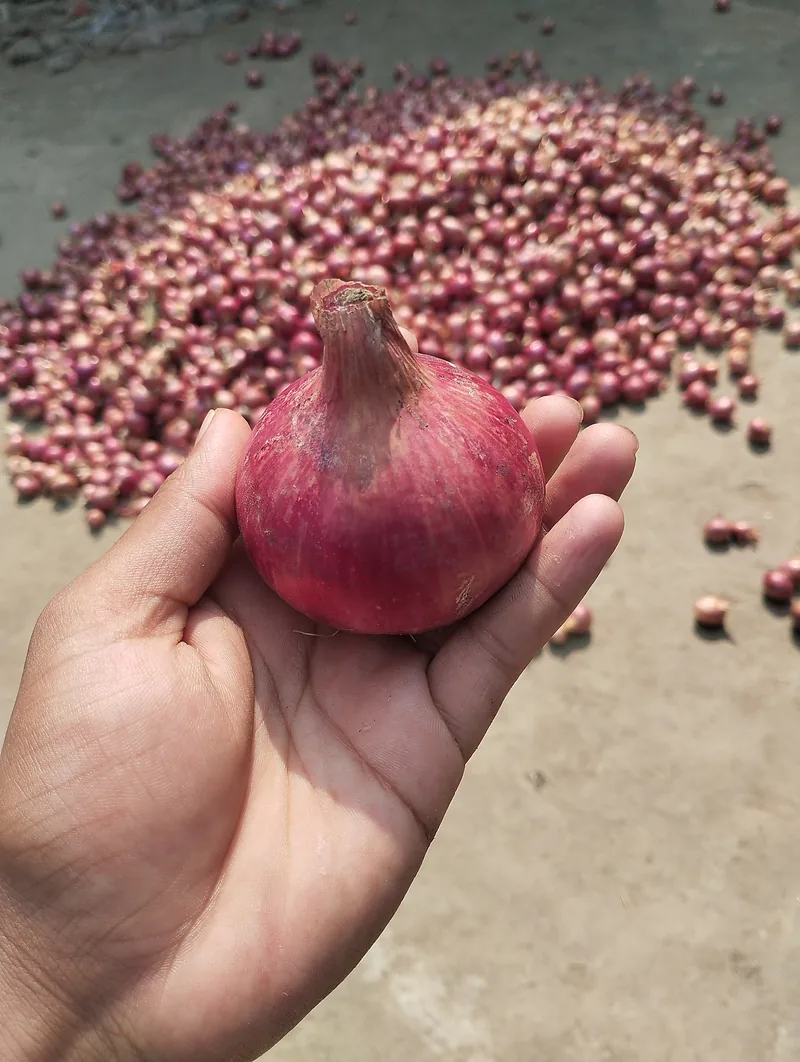
Sets grow “quickly and reliably, with minimal maintenance,” but they “are more prone to bolting.” “Using heat-treated sets greatly reduces the risk of bolting.” [source] Plant them “2cm (¾in) deep,” with the tip just showing, “10-15cm (4–6in) apart” in rows “20–30cm (8–12in) apart.” Wider spacing gives larger bulbs. [source] “Birds will often peck newly planted sets out of the ground, so protect with biodegradable fleece or netting until they’ve rooted in.” [source]
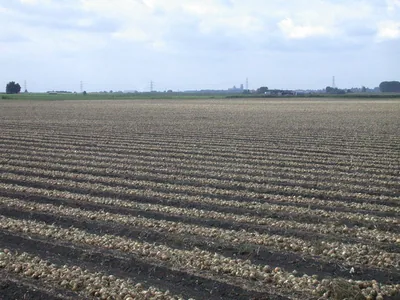
Seed “takes a little more time and care,” but “seeds are generally cheaper to buy and you’ll have a greater choice of varieties.” [source] They also “don’t stay viable for long, with germination rates declining after a year or two.” [source] Sow indoors from mid-winter to early spring, 1.3cm (½in) deep, and have the plants “growing strongly by late spring, as the lengthening days trigger the formation of bulbs — the more leaves that plants have at this time, the better the bulb will be.” [source] Don’t split multi-seeded modules; plant the clump as it is. [source]
A limited range of autumn sets is “usually sold as overwintering or Japanese onions, for an earlier crop.” [source] They are ready in June and July. Spring-planted sets and seed-raised onions are ready from July to October. [source] “A warm, sunny spot in well-drained soil is ideal,” and onions “can also be grown in large containers.” [source] For the cluster that grows from a shallot set, see shallots. For the crop you sow little and often, see salad onions.
Enjoyed this desk of sets, shallots, and a store that wants the light?
No pop-ups. No intrusive advertising. Just interesting stuff. A little support helps the next vegetables.im site get built.